

- Joined
- Nov 21, 2019
- Messages
- 6,796
- Reaction score
- 124,439
- Points
- 11
- Age
- 55
- Location
- Орёл
- 💎VM
- 436,613.00
- New country
- 🌐Единия
- Enneatype
- 5 (?)
- Gender
- Male
- Ashram resident
- Yes
You are currently in the paid practices section of the Mahapurna School — Paid Practices
This is a rare protective Tibetan mantra. It is little known even among Buddhists, let alone on the internet.
Before giving you this meditation and, essentially, protective practice, I want to tell you a little about what Tibetan Buddhism actually is.
By the way, I practiced Tibetan Buddhism in the Karmapa tradition for a long time.
So I am not just some theoretician. I always try to get to the very depths of things.
And everything I most often write to you on the Your Yoga website, in my schools, academies, and social networks is filtered through my experience.
And if some experience is absent in this life, I draw it from the past or the future.
Before understanding what Tibetan Buddhism is, you first need to understand what Tibet itself is. Or, more precisely, what Tibet was before Tibetan Buddhism.
It was a land of magic and tantra.
If you have studied even a little Tibetan Buddhism, you know that its origins lay with yogis, tantrikas, and magicians.
And the establishment of Buddhism in Tibet was a long and difficult process. Because Buddhism upholds nonviolence. Even if a person needs to defend themselves, a Buddhist cannot do so.
Before Buddhism, however, magic reigned in Tibet.
And it was magic of such power that a single magician could destroy an entire village. At the same time, another magician could protect that village from the first one.
In other words, these were magical battles.
People really flew through the air. By the way, they still fly there now.
Because Tibetan Buddhism is, at present, half Buddhism and half the teaching that existed in Tibet before it. That is, magic and tantra.
And what I am giving you now is precisely that power, that teaching which enables anyone to protect themselves from black magic.
Because in Tibet they know very well what that is. There it is a reality. There, in order to survive, one must possess the knowledge of how to protect oneself from black magic.
Therefore, one enlightened bodhisattva of Tibet (who received it from the Buddha) gave people a mantra and infused it with his power so that ordinary people could use this mantra to protect themselves from black magic.
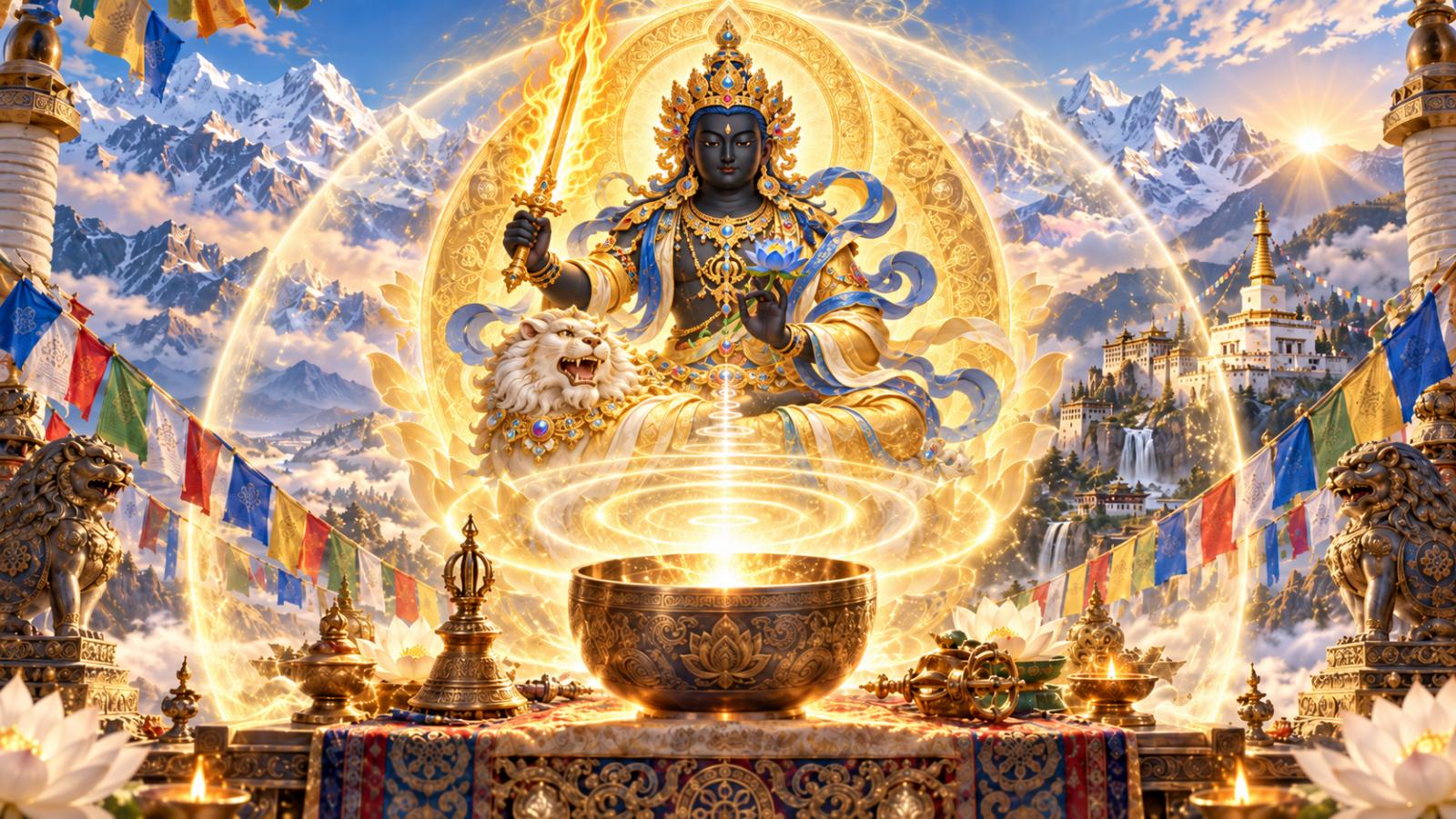
Specifically from black magic, from all kinds of influence and effects of black-magic energies, as well as from the negative forces of the cosmos and the Earth that emanate from evil spirits.
ACTIVATE THE PROTECTIVE TIBETAN MANTRA:
More precisely, the words in the mantra are not quite Sanskrit. They are Sanskrit seed syllables. Bija means “seed.” That is, these are sounds that existed beforewords.
Therefore, there is no translation here. Because the meaning is concealed here before words. In a world where there are no words yet.
Therefore, it has no translation in the manner of ordinary mantras. Some syllables serve a ritual and sonic (vibrational) function; certain fragments convey the meaning of action, cessation, or elimination, but translating the entire formula as a literary text would be inaccurate.
In other words, this is not a prayer in which a person tells Manjushri about their problems. It is rather a sound formula of wrathful wisdom, associated with a specific image, visualization, and lineage of transmission.
As an independent practice, the practice of "Black Manjushri" was transmitted from India to Tibet by the translator Bari Lotsawa Rinchen Drak, who lived from 1040 to 1112. The transmission then passed to Sachen Kunga Nyingpo, one of the founders of the Sakya spiritual system. Himalayan Art gives the traditional lineage:
Buddha → Vajrapani → Jetari → the elder and younger Vajrasana → Bari Lotsawa → Sachen Kunga Nyingpo → subsequent Sakya masters.
Therefore, this mantra is most likely about a thousand years old in its Tibetan form, while its Indian foundations may be even older—by several thousand years.
You can see that this practice comes from the Buddha himself.
And the Buddha, as you know, was born in India, the land of the Vedas and Vedic culture. In other words, this is oneone of Vishnu’s incarnations, just like Krishna and Rama.
At the beginning and end of the audio recording of this meditation, I added another Tibetan mantra that enhances what you have done a thousandfold.
In other words, imagine this: you practice with the help of this meditation, which I created for you, using a protective formula against black magic, and with the help of the additional Tibetan mantra, you amplify it all a thousandfold.
Here is this additional mantra:
The meditation style is not classically Tibetan, although you will feel the Tibetan tradition in this meditation.
However, I also added some shamanic touches.
So it turned out to be something between the style of shamans and Tibetan throat singing.
This is a rare protective Tibetan mantra. It is little known even among Buddhists, let alone on the internet.
Before giving you this meditation and, essentially, protective practice, I want to tell you a little about what Tibetan Buddhism actually is.
By the way, I practiced Tibetan Buddhism in the Karmapa tradition for a long time.
So I am not just some theoretician. I always try to get to the very depths of things.
And everything I most often write to you on the Your Yoga website, in my schools, academies, and social networks is filtered through my experience.
And if some experience is absent in this life, I draw it from the past or the future.
Before understanding what Tibetan Buddhism is, you first need to understand what Tibet itself is. Or, more precisely, what Tibet was before Tibetan Buddhism.
It was a land of magic and tantra.
If you have studied even a little Tibetan Buddhism, you know that its origins lay with yogis, tantrikas, and magicians.
And the establishment of Buddhism in Tibet was a long and difficult process. Because Buddhism upholds nonviolence. Even if a person needs to defend themselves, a Buddhist cannot do so.
Before Buddhism, however, magic reigned in Tibet.
And it was magic of such power that a single magician could destroy an entire village. At the same time, another magician could protect that village from the first one.
In other words, these were magical battles.
People really flew through the air. By the way, they still fly there now.
Because Tibetan Buddhism is, at present, half Buddhism and half the teaching that existed in Tibet before it. That is, magic and tantra.
And what I am giving you now is precisely that power, that teaching which enables anyone to protect themselves from black magic.
Because in Tibet they know very well what that is. There it is a reality. There, in order to survive, one must possess the knowledge of how to protect oneself from black magic.
Therefore, one enlightened bodhisattva of Tibet (who received it from the Buddha) gave people a mantra and infused it with his power so that ordinary people could use this mantra to protect themselves from black magic.
Specifically from black magic, from all kinds of influence and effects of black-magic energies, as well as from the negative forces of the cosmos and the Earth that emanate from evil spirits.
ACTIVATE THE PROTECTIVE TIBETAN MANTRA:
The audio language is Sanskrit.
More precisely, the words in the mantra are not quite Sanskrit. They are Sanskrit seed syllables. Bija means “seed.” That is, these are sounds that existed beforewords.
Therefore, there is no translation here. Because the meaning is concealed here before words. In a world where there are no words yet.
Therefore, it has no translation in the manner of ordinary mantras. Some syllables serve a ritual and sonic (vibrational) function; certain fragments convey the meaning of action, cessation, or elimination, but translating the entire formula as a literary text would be inaccurate.
In other words, this is not a prayer in which a person tells Manjushri about their problems. It is rather a sound formula of wrathful wisdom, associated with a specific image, visualization, and lineage of transmission.
As an independent practice, the practice of "Black Manjushri" was transmitted from India to Tibet by the translator Bari Lotsawa Rinchen Drak, who lived from 1040 to 1112. The transmission then passed to Sachen Kunga Nyingpo, one of the founders of the Sakya spiritual system. Himalayan Art gives the traditional lineage:
Buddha → Vajrapani → Jetari → the elder and younger Vajrasana → Bari Lotsawa → Sachen Kunga Nyingpo → subsequent Sakya masters.
Therefore, this mantra is most likely about a thousand years old in its Tibetan form, while its Indian foundations may be even older—by several thousand years.
You can see that this practice comes from the Buddha himself.
And the Buddha, as you know, was born in India, the land of the Vedas and Vedic culture. In other words, this is oneone of Vishnu’s incarnations, just like Krishna and Rama.
At the beginning and end of the audio recording of this meditation, I added another Tibetan mantra that enhances what you have done a thousandfold.
In other words, imagine this: you practice with the help of this meditation, which I created for you, using a protective formula against black magic, and with the help of the additional Tibetan mantra, you amplify it all a thousandfold.
Here is this additional mantra:
OM SAMBARA SAMBARA BIMANA SARA MAHA DZAVA HUNG
The meditation style is not classically Tibetan, although you will feel the Tibetan tradition in this meditation.
However, I also added some shamanic touches.
So it turned out to be something between the style of shamans and Tibetan throat singing.
Last edited:
 !
!


