Chronotypes

Веретенников Сергей

ОМ Шанти

Сергей Васильевич

Админ.
З.Клуб
О.Клуб
К+
Joined
Nov 21, 2019
Messages
6,792
Reaction score
124,316
Points
11
Age
55
Location
Орёл
💎VM
432,548.50
New country
🌐Единия
Enneatype
5 (?)
Gender
Male
Ashram resident
Yes
This topic is dedicated to the Game we play at our School, here: Game – Game: The Inner Clock

Until quite recently, it was believed that there were only two chronotypes: the so-called night owls and early birds.

The list has now expanded to six.

Scientists discovered the per (period) gene in fruit flies, which is responsible for the length of subjective days. In the mid-1980s, the same DNA segment was found in mice. Later, several genes associated with the regulation of circadian rhythms were identified in mammals, including clock, tim, and bmal. It turned out that they are present in the nuclei of all the body’s cells but are active only in neurons of the suprachiasmatic nuclei in the front part of the hypothalamus. They have been shown to regulate melatonin secretion and synchronize the body’s biological clocks.

As a rule, this activity is adjusted to the light cycle of the area where a person lives.

In 2015, scientists supplemented the classic division into night owls and early birds with two more chronotypes — high-energy and sleepy. People belonging to the first type are highly active throughout the day. Those belonging to the second feel exhausted around lunchtime but full of energy in the mornings and evenings.

Four years later, the study’s authors improved the questionnaire and surveyed 1,305 people. Once again, the data obtained showed a division into four main chronotypes.

Recently, scientists from an international group expanded the classification with two more chronotypes — in addition to the known ones, they added a daytime-active type, whose representatives are alert during daylight hours, and a moderately active type, characterized by a gradual decline in activity throughout the day.
The researchers tested 2,283 people. Of these, 95% identified with one of the six proposed chronotypes. Most participants decided that they were night owls (24%), while 13% classified themselves as early birds. The daytime-active type was chosen by 15% of the volunteers, the moderately active type by 16%, and another 9% by the highly active type (also known as the high-energy type). The remaining 18% admitted that they felt full of energy in the mornings and evenings — meaning they turned out to be representatives of the daytime-sleepy type.
 

Веретенников Сергей

ОМ Шанти

Сергей Васильевич

Админ.
З.Клуб
О.Клуб
К+
Joined
Nov 21, 2019
Messages
6,792
Reaction score
124,316
Points
11
Age
55
Location
Орёл
💎VM
432,548.50
New country
🌐Единия
Enneatype
5 (?)
Gender
Male
Ashram resident
Yes
Biological clocks are one of the body's systems, like the immune or cardiovascular systems. These clocks are needed by all living beings to synchronize with the rhythms of nature—to adjust to the change between day and night or the changing seasons. Many bodily functions, including thermoregulation, blood pressure, and hormone production, are governed by biological clocks.

The clocks that control our bodies operate on three levels. The first is a tiny clock mechanism hidden in every cell. For discovering it, American researchers Jeffrey Hall, Michael Rosbash, and Michael Young received the 2017 Nobel Prize in Physiology or Medicine.

A key role in it is played by special clock proteins, which are synthesized in all cells containing a nucleus—in animals, plants, and fungi alike. Some clock proteins are produced in the morning, activating metabolism in the cell, while others are produced in the evening, slowing metabolism. This is how the daily, or circadian (from the Latin circa—around and dies—day), rhythm of an individual cell's activity is established. If one of the genes that synthesize clock proteins mutates, various bodily rhythms may be disrupted: sleep and wakefulness, motor activity, and digestion. All these rhythms are connected—if a person does not sleep at night, this may lead not only to insomnia or depression, but also to diabetes and even cancer.

A clock is needed not only by every cell, but also by the body as a whole. The rhythms of all cells are synchronized by a special hormonal gland in the brain called the epiphysis, or pineal gland, which produces melatonin and serotonin—hormones that regulate our sleep and wakefulness, as well as appetite and mood. During daylight hours, the pineal gland produces the “happiness hormone” serotonin, while in the dark, serotonin is converted into the “sleep hormone” melatonin, which makes sleep deeper and more restorative.

Melatonin is produced in sufficient quantities only in darkness; even dim light reduces its production—turn off all the lamps and cover the windows! Serotonin, on the other hand, needs light: the more light there is, the better the mood and the higher the productivity.

Now let us move on to the third level. The supreme control center for all the body's rhythmic functions is the suprachiasmatic nuclei of the hypothalamus. It is precisely this group of nerve cells that receives a direct signal from the retina, telling the clocks whether it is currently day or night outside. This small area in the diencephalon is the main generator of daily rhythms; its neurons adjust to external light signals and control the pineal gland.

Scientists from the University of California, San Diego, the University of California, Santa Cruz, and Duke University studied what makes our biological clocks “tick.” In particular, they wanted to understand why some people, known as early birds, live on a shorter 20-hour cycle compared with the usual 24-hour one. This difference of several hours can ultimately lead to disruption of the body's daily rhythm and sleep, and therefore to an inability to function in sync with the rest of society.

Properly adjusted biological clocks, in turn, may delay the onset of degenerative diseases and prevent certain metabolic conditions, such as diabetes and obesity.
 

Веретенников Сергей

ОМ Шанти

Сергей Васильевич

Админ.
З.Клуб
О.Клуб
К+
Joined
Nov 21, 2019
Messages
6,792
Reaction score
124,316
Points
11
Age
55
Location
Орёл
💎VM
432,548.50
New country
🌐Единия
Enneatype
5 (?)
Gender
Male
Ashram resident
Yes
02:00 - The deepest sleep

03:00 - The lowest blood pressure

04:30 - The lowest body temperature

06:45 - The sharpest rise in blood pressure

07:30 - Melatonin secretion stops

08:30 - The urge to defecate may occur

10:00 - The highest readiness for active pursuits

14:30 - Maximum coordination

15:30 - The fastest reaction time

17:00 - The most active blood circulation and maximum muscle strength

18:30 - The highest blood pressure

19:00 - The highest body temperature

21:00 - Melatonin secretion begins

22:30 - Intestinal peristalsis is suppressed
 

Веретенников Сергей

ОМ Шанти

Сергей Васильевич

Админ.
З.Клуб
О.Клуб
К+
Joined
Nov 21, 2019
Messages
6,792
Reaction score
124,316
Points
11
Age
55
Location
Орёл
💎VM
432,548.50
New country
🌐Единия
Enneatype
5 (?)
Gender
Male
Ashram resident
Yes
It is especially harmful to constantly change your routine. For example, scientists from the University of Michigan studied the database of the Nurses’ Health Study project—a long-term study of the health of more than 120,000 American nurses—and found that shift work (switching between day and night shifts) increases the risk of ischemic stroke by 4% every five years. Other studies based on the same data showed that working night shifts at least three nights a month for 15 years or more may increase the risk of colorectal and breast cancer.

The reason is desynchronosis, that is, a misalignment of biological rhythms, which is a risk factor for cardiovascular and oncological diseases. Desynchronosis is accompanied by prolonged increased fatigue, reduced work capacity, and sleep disturbances.

One-time desynchronosis is familiar to anyone who has experienced jet lag—the syndrome that occurs when the time zone changes abruptly, when a person crosses more than three or four time zones. This is followed by a stage of resynchronization, when the body’s biological rhythms adapt to the new conditions. Interestingly, if the flight was from east to west, the average recovery rate is 92 minutes per day, while if it was from west to east, it is one and a half times lower, at 57 minutes per day. Thus, adapting when flying east is more difficult.

Our bodies also sense this desynchronization when we pass the time with a smartphone. It is specifically the blue, short-wavelength part of the color spectrum that suppresses melatonin production. The photopigment melanopsin in the cells of the eye’s retina responds to blue light—it is what determines whether the brain perceives it as night or day. Under red light, the brain does not understand that it is daytime outside. But gadget screens emit bright, cool blue light, needlessly keeping the brain alert in the middle of the night.
 

00* 243

З.Клуб
О.Клуб
Рег.
ОТГ-1
ОТГ-2
Род-1
Joined
Oct 25, 2020
Messages
124
Reaction score
726
Points
19
Age
35
Location
Единия
💎VM
522.50
Gender
Male
Ashram resident
No
THE POWER OF TIME. Brahma Muhurta. Dinacharya (daily routine).
Rising from Sleep (PRATARUTTHANA)

Ashtanga Hridaya Samhita:
Book One, “Sutrasthana”
Chapter 2 (Dinacharya), Verse 1:
The Power of Time,
Brahma Muhurta,
Sharira Chinta

Vāgbbhaṭa Aṣtāṅgahṛdaya
Sutrasthāna 2 – dinacaryādhyādhyāya

brahme muhūrta uttiṣṭhet svastho rakṣārtham ārtham āyuṣaḥ |
ṣarīra-cintāṃ nirvartya kṛta-śauca-vidhis tataḥ ||1||
Chapter 2. Dinacharya Adhyaya (daily routine). Now we shall explain the chapter Dinacharya Adhyaya (daily routine)—thus spoke Atreya and the other sages. 1. A healthy person should rise from bed during Brahma Muhurta in order to protect their life.

Commentary. The mystery of human life is played out every day. Awakening symbolizes birth, morning—childhood and youth, noon—young adulthood, the daytime hours—maturity, evening—old age, and falling asleep—death. Therefore, circadian (daily) rhythms are symbolically connected with the various stages of life, and they should not be neglected. Each period of the day is associated with the dominant influence of one of the gunas of nature (sattva, rajas, or tamas). If a person is accustomed to going with the flow without reflecting on what is happening around them or engaging in spiritual practices, they will most likely find themselves in the least desirable states of consciousness. Brahma Muhurta is a special period associated with nirguna. It is the best time to enter a transcendental state of consciousness using various mantras, pranayamas, prayers, and meditation. Brahma Muhurta begins an hour and a half before sunrise and lasts an average of 48 minutes, depending on geographical latitude and the season. It is precisely at this time that Atreya and the other sages recommend awakening from sleep to engage in spiritual practices. In the East, many temples still begin their worship services at this very time. Monks and sadhus focus their minds on the Supreme, offering Him prayers, glorifying Him, and repeating His holy names. If a person develops the habit of rising from bed during Brahma Muhurta and practicing meditation, their spiritual life will develop successfully. The thoughts that arise in our minds at this time will have a strong influence on the entire following day. Sattva-guna (the mode of goodness) manifests most strongly at sunrise and sunset, as well as during the 30 minutes preceding them and the hour and a half following them. At sunrise and sunset, the etheric body and the neuroendocrine system naturally undergo reprogramming. The organism itself adjusts the mechanisms responsible for maintaining homeostasis (the constancy of the internal environment). At this time, Ayurveda does not recommend sleeping, eating, engaging in sexual relations, or performing strenuous physical or psycho-emotional work. If a person disregards this advice, their body is unlikely to remain healthy for long. It is said that violating this routine can lead to premature aging.


190519

З.Клуб
О.Клуб
Рег.
ФАН
Joined
Dec 19, 2024
Messages
41
Reaction score
342
Points
13
💎VM
220.90
New country
🌐Единия
Gender
Female
Ashram resident
Yes
00* 243 00* 243 , thank you for the detailed and very valuable information 🙏🏻
 

00* 243

З.Клуб
О.Клуб
Рег.
ОТГ-1
ОТГ-2
Род-1
Joined
Oct 25, 2020
Messages
124
Reaction score
726
Points
19
Age
35
Location
Единия
💎VM
522.50
Gender
Male
Ashram resident
No
Что такое джетлаг и как с ним бороться

Как смена часовых поясов влияет на организм, сон и концентрацию
Джетлаг — это временное расстройство сна из-за быстрой смены часовых поясов. У нас в теле есть внутренние биологические часы, которые помогают засыпать, просыпаться и хотеть есть примерно в одно и то же время. Из-за быстрой смены часовых поясов эти внутренние часы не успевают подстроиться и продолжают работать в привычном режиме.

Из-за этого начинаются сложности, например:
  • появляются усталость и разбитость, меняется настроение в течение дня;
  • не получается заснуть, трудно просыпаться, человек не высыпается;
  • снижается концентрация внимания;
  • увеличивается вероятность запора или поноса.
По всей видимости, джетлаг не ухудшает хронические состояния, но снижает сопротивляемость организма вирусным заболеваниям. Учитывая, что аэропорты — одни из самых рисковых с точки зрения инфекций мест, есть большая вероятность подхватить ОРВИ. Поэтому мойте руки и старайтесь минимизировать усталость от джетлага.

Количество часовых поясов. Чем больше мы пересекаем часовых поясов за раз, тем вероятнее получить джетлаг и тем дольше восстанавливаться. Обычно организм адаптируется к двум пересеченным часовым поясам за день.Это значит, что после трехчасового перелета из Берлина в Москву организм восстановится за сутки, а после десятичасового перелета из Бангкока будет приходить в норму дней пять.
Солнечный свет. Он регулирует работу внутренних биологических часов через мелатонин — гормон, который синхронизирует работу клеток всего организма. Если вы прилетаете днем, а по вашим внутренним часам ночь и вы задергиваете шторы, то биологическим часам сложнее синхронизироваться с новым временем.
Удобно, когда вылетаешь из Владивостока в 11:00, а в Москву прилетаешь в 12:00: это еще тот же день и все еще светло. Также удобно вылетать ночью и прилетать ночью, чтобы сразу ложиться спать. Но проблема в том, что не всегда есть подходящие рейсы.
Направление полета. Лететь на восток сложнее, чем на запад. Ученые не знают, почему точно, но одно из объяснений заключается в физиологии клеток мозга, которые производят мелатонин. Судя по всему, мозгу физически сложнее перестраиваться именно в полете на восток.

Частота перелетов. Те, кто часто летает и, соответственно, часто испытывает джетлаг, страдают от него больше. К сожалению, привыкания к этому нет.
Возраст. Пожилым путешественникам нужно восстанавливаться дольше.
Как можно минимизировать риски и последствия длительных перелетов: 1)что делать перед полетом, 2)во время 3)и уже на месте.

Шаг 1
Как готовиться к полету
Летите отдохнувшими. Не напивайтесь и не ходите по вечеринкам накануне путешествия. Недосып и усталость ухудшают последствия джетлага. Вместо этого позанимайтесь спортом, сходите в баню и хорошо выспитесь.
Измените свой режим за пару-тройку дней до полета. Если летите на восток, ложитесь спать на час раньше обычного, если на запад — на час позже. Подстройте время приема пищи: сдвиньте его на час вперед или назад в зависимости от направления.
Контролируйте яркость света. Яркое вечернее освещение помогает заранее адаптироваться к позднему западному часовому поясу, а утреннее — к более раннему восточному. Работает просто: чем больше света, тем меньше секретируется мелатонин и тем меньше сонливость.

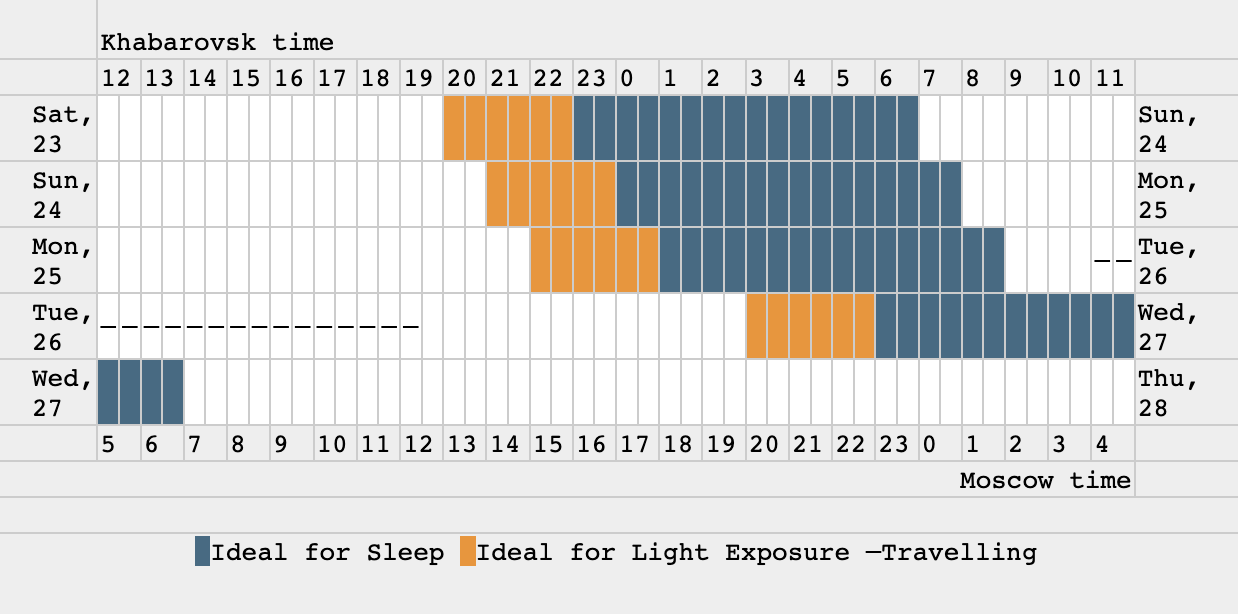
Если вы летите из Владивостока в Москву, включайте больше ламп вечером, ложитесь спать позже и носите солнцезащитные очки утром. Если из Москвы во Владивосток — вставайте раньше, зажигайте больше света утром. Чтобы понять, в какое время добавлять больше света или делать его меньше, поэкспериментируйте с калькулятором Jet Lag Rooster.
Например, я вылетаю 26 апреля из Хабаровска в 11:00, прилетаю в 12:30 в Москву. Калькулятор прикидывает такой режим: за три дня до полета включать усиленный свет за три часа до сна, каждый день ложиться на час позже. По прилете продолжить включать дополнительный свет перед сном и ложиться в обычное время уже по местному часовому поясу

Например, я вылетаю 26 апреля из Хабаровска в 11:00, прилетаю в 12:30 в Москву. Калькулятор прикидывает такой режим: за три дня до полета включать усиленный свет за три часа до сна, каждый день ложиться на час позже. По прилете продолжить включать дополнительный свет перед сном и ложиться в обычное время уже по местному часовому поясу

Шаг 2
Что делать во время полета
Пейте воду, но избегайте кофе, алкоголя и высокоуглеводных блюд. Из-за давления в салоне самолета на высоте в крови становится меньше кислорода и воды. Поэтому важно пить воду, а алкоголь — нет, потому что он усиливает обезвоживание. Кофеин вносит смуту в и так сбитые внутренние часы, а еда подается не в привычное время.
Ешьте тогда, когда привыкли. Выбирайте легкоусвояемую еду вроде салатов. Это сложно, учитывая, что меню в рейсах преимущественно углеводное. Поэтому, если не голодны, подождите прилета и поешьте по местному времени.

Если в пункте назначения во время прилета ночь — спите, если день — терпите. Беруши, наушники и маски для глаз помогут отгородиться от шума и света. Если там, куда вы летите, день, старайтесь не спать. Когда я лечу из Хабаровска в Москву утренним рейсом — вылетаю в 11:00 и прилетаю в 12:00, — позволяю себе подремать, чтобы осталось больше сил по прилете.
Переведите время на часовой пояс города, в который летите. Это психологическая уловка, которая работает конкретно у меня. Сел в самолет, перевел часы на новое местное время — вроде уже легче.
Пейте мелатонин. Если по предыдущему опыту знаете, что переносите джетлаг тяжело, примите мелатонин. Это препарат, который помогает биоритмам восстановиться. Его не стоит употреблять при обычных проблемах со сном без консультации с врачом, но во время перелетов
Принимайте 0,5 мг мелатонина за 13 часов до того момента, когда вы планируете проснуться по будильнику. Более высокие дозы могут вызвать проблемы с пробуждением. Начинайте принимать препарат за несколько дней до вылета, чтобы помочь организму войти в режим. Прекратите прием в день вылета.

Что делать по прилете
Постарайтесь не спать до наступления местной ночи независимо от того, насколько вы устали. Если совсем невмоготу, поспите, но не больше 20—30 минут. Короткий сон поможет немного восстановиться, но чем дальше, тем больше сонная инерция и тем сложнее будет войти в новый ритм. Выпейте чашку кофе перед таким коротким сном, ко времени пробуждения кофеин пройдет путь от ЖКТ к мозгу и даст дополнительный буст к энергии.

Идите гулять, не избегайте солнечного света. Это поможет облегчить адаптацию к новому часовому поясу.
Пейте много воды. Обычной, негазированной — уже после полета. Если не пить достаточно воды, можно получить легкое обезвоживание, которое также способно повлиять на появление симптомов джетлага.

Если прилетели буквально на день за 2—4 часовых пояса, попробуйте вообще не менять часовой пояс и режим. Если возможно, пусть окружающие подстраиваются под вас. Здесь главное — не пропустить время обратного рейса.
Запомнить
  1. Полностью джетлаг победить невозможно, потому что эволюция нас не готовила к тому, чтобы за десять часов полета так сильно переводить внутренние биологические часы. К сожалению, эффект будет всегда, но в наших силах его немного минимизировать.
  2. Летите отдохнувшими; измените режим дня за пару дней до полета; контролируйте яркость света; по возможности летите бизнес-классом и отдыхайте на полную.
  3. В полете пейте воду, а алкоголь и кофе не употребляйте; поспите, если летите туда, где ночь; примите мелатонин; переведите время на часовой пояс города, куда летите.
  4. По прилете постарайтесь не спать до наступления местной ночи; идите гулять и не избегайте солнечного света; продолжайте пить побольше воды.

    Также есть музыка с бинуаральными частотами, можно поискать по запросу "anti jet lag/Relieve Jet Lag music" (музыка с тета и дельта частотами подходит)
 
Last edited:

00* 243

З.Клуб
О.Клуб
Рег.
ОТГ-1
ОТГ-2
Род-1
Joined
Oct 25, 2020
Messages
124
Reaction score
726
Points
19
Age
35
Location
Единия
💎VM
522.50
Gender
Male
Ashram resident
No
Ayurvedic Recommendations for Sleep
20.08.2019 20856

There is one basic principle that helps determine the amount of sleep each individual needs. If, upon waking, you feel alert, refreshed, and optimistic, then you have slept exactly as long as your body requires. If, however, you feel tired and stiff upon waking, you most likely slept for an unsuitable amount of time—perhaps too little or, conversely, too long.
If you sleep more than 8 hours and do not feel very comfortable as a result, try gradually reducing your sleep time each day until you notice that you feel refreshed and energized after getting up. Of course, this does not apply to situations in which it is impossible to get adequate sleep and this condition arises, on the contrary, from sleep deprivation and the fact that the body simply does not have time to rest.
Daytime sleep negatively affects digestion, liver function, and the body’s lymphatic and blood circulation. This habit disrupts breathing, interferes with the normal functioning of the organs in the chest area, causes heaviness in the head, and leads to many other disorders. From the Ayurvedic perspective, sleeping during the day after working at night is also considered improper. However, those who are forced to work at night soon adapt to this schedule, and daytime sleep is permissible for such people.

The best time for sleep is considered to be the period beginning three hours after sunset and ending 90 minutes before sunrise. Going to bed on a full stomach diverts a great deal of energy intended to restore the body’s strength, increases the influence of the tamas guna in the body, and also leads to bad dreams.

Ayurvedic masters believe that half an hour before sunrise, the Sun sends out special rays that penetrate the atmosphere and give the human body special energy. In modern times, Japanese researchers have recorded that approximately 20 minutes before sunrise, the body’s entire biochemistry changes dramatically. The psyche becomes most receptive, and even the composition of the blood changes. This is the best time to form positive neuroprograms. Therefore, it is recommended to remain awake during this period. The energy given to us by the Sun should be received by a clean body, and then the body will function normally throughout the day. The most suitable activities at this time are meditation and techniques that transform consciousness.

In addition, during this period the vata dosha is active; it is responsible for removing waste products from the body. Therefore, if a person gets up earlier, vata dosha can work better and cleanse the body of toxins more effectively.

If you feel drowsy, this does not necessarily mean that you have not slept enough. It may result from an excess of toxins in the body. Weakness and reduced digestive fire can also cause drowsiness. This should not be addressed by sleeping. First and foremost, it is necessary to eliminate the cause leading to this condition.

The quality of rest during sleep depends most of all on how we eat. After eating before bed, the body works hard during sleep and does not rest, and bad dreams occur; one should eat no less than 3 hours before sleep.

Some Ayurvedic recommendations regarding sleep:
1. Before bed, wash your feet with cool water and then rub them with oil—this is a natural sedative. If a person massages their feet with sesame oil every day, they will never become ill, as this restores their immune system.

2. Before bed, spend a few minutes doing breathing exercises or meditating.

3. While sleeping, it is preferable to wear as little clothing as possible; choose clothing made from light, natural fabrics. It is especially harmful to sleep in socks.

4. It is recommended to sleep with your head facing east.

5. Never sleep in the kitchen, and do not store food in the bedroom.

6. Do not cover your face with a blanket while sleeping. The habit of covering the face is very harmful because it forces you to breathe air that has already been exhaled.

7. Sleeping outdoors in summer is very beneficial, but if there is fog, rain, or excessively high humidity outside, it is better to sleep indoors.

8. Sleeping on a damp or wet bed is very harmful; the bed should be comfortable.

9. Ayurveda recommends sleeping on one’s side. Sleeping on the left side facilitates digestion and gives a person energy, while sleeping on the right side allows for proper rest. This is because when a person sleeps on the left side, the right nostril is primarily active, providing the body with positive energy and helping digestion and warmth. If the room is cold, lie on your left side, and the body’s natural warmth will be maintained.

10. Ayurveda does not recommend sleeping on your back. This is especially harmful for people of the vata type, because both nostrils begin working and the body’s balance is disrupted (vata dosha becomes agitated).

11. Sleeping on your stomach is worst of all because it completely disrupts breathing. Sleeping under the open Sun is very harmful, while sleeping under the open moon is beneficial.

12. By sleeping too little or not going to bed at all, you seriously harm your health. This dries out the body and weakens the digestive fire.

13. Try to get up early and go to bed early. With a proper sleep schedule, health improves and vitality increases.

14. Sleeping at sunset is especially harmful to the body. Eating at this time of day also disrupts digestion and is therefore highly undesirable.

15. Sleeping during the day leads to respiratory diseases, heaviness in the head, and a number of other disorders. Daytime sleep is permitted for healthy people who are tired from heavy physical labor, as well as for patients experiencing severe pain or suffering from respiratory diseases and nausea. A short nap is also allowed for patients with gastrointestinal disorders, as well as for those who are fasting and feel the desire to doze. People living in very warm climates may benefit from sleeping a little during the hottest, most unbearable hours of the day; they should rest only in a shady, cool place.

16. Those who go to bed with a tightly filled stomach will not get sufficient rest during sleep and will be unable to digest food fully; in this case, the amount of toxins in the body increases.

17. The air in the room where you sleep should be fresh. Sleeping in a stuffy, poorly ventilated room is very harmful.

18. According to Ayurveda, if a person has been unable to sleep at night (not out of habit), they should sleep for half the prescribed amount of time the following morning without eating.

19. Those suffering from insomnia or insufficient sleep are advised to drink warm milk with a pinch of nutmeg and several strands of saffron, receive an oil massage, take baths, and seek refuge in a feeling of calm and pleasant memories. This will make up for a good night’s sleep.

20. Pregnant women are not advised to oversleep, as this may cause the child to be lazy.

Based on the book "Ayurveda for Every Day" by S. M. Neapolitan
 

00* 243

З.Клуб
О.Клуб
Рег.
ОТГ-1
ОТГ-2
Род-1
Joined
Oct 25, 2020
Messages
124
Reaction score
726
Points
19
Age
35
Location
Единия
💎VM
522.50
Gender
Male
Ashram resident
No

At the end of the video, for informational purposes, a technique from ancient Hatha Yoga is presented: the Diamond Wave (rdo rje rba rlabs),
where the practitioner or teacher presses on the carotid arteries on the sides of the neck to induce a thought-free state of bliss and emptiness (de stong). The “Diamond Wave” is one of twenty-one yogic methods for attaining the state of primordial awareness (rig pa). This technique is described by the famous Buddhist yogin Orgyen Pema Lingpa in “An Introductory Commentary to the Pearl Garland of Introduction [в природу разума] in Six Sections.”
Алмазная Волна ( rdo rje rba rlabs.png
 
Shoutbox
  1. No shouts have been posted yet.
Top Bottom